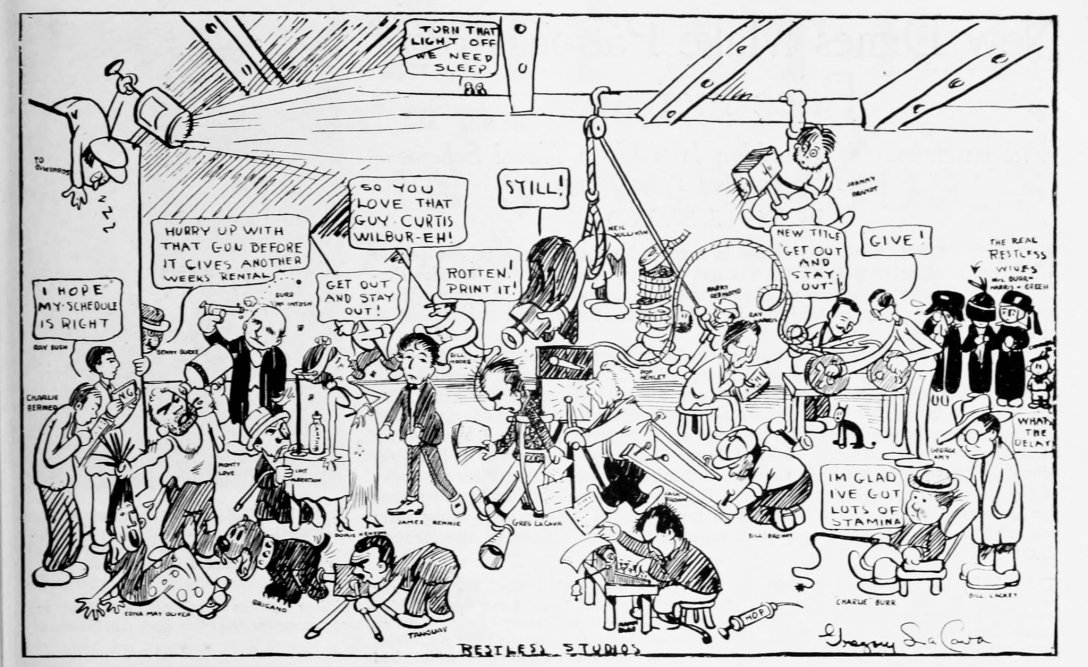
Gregory La Cava’s last years as an animation director were pretty important to La Cava’s transition to the live action world. His relationship with Educational Film Exchanges, Inc, started in around 1918 when his animation shorts began being distributed by them, and this lead to La Cava working at C.C Burr studios, where La Cava became quickly familiar with the high strung chaos of little budget and little time. La Cava joining the live action motion picture industry can be interpreted as an act of necessity due to the collapse of the International Film Service 1919, but, as mentioned in my last post, La Cava’s pull to film was always of a very human nature.
La Cava did not go to Hollywood immediately, so in this post I’m focusing on La Cava’s work at the Long Island studios of C.C. Burr and his All Star Comedies. La Cava’s first real involvement with the motion picture industry being with an independent producer who was also relatively new to the film industry is rather explanatory for La Cava’s later relationship with the Hollywood studios. The environment was characterised by constant change and honing of craft and audience interest, with C.C. Burr being an ad man from Brooklyn; the established popularity of comedy makes his abandoning of the Mastodon Film production name1 an understandable and profitable move. Burr’s focus was on showcasing the talent he held under contract, and he appeared to rely on the same group of talent behind the lens too.
It’s important to note the film industry in New York at the time, and I highly recommend listening to the Oral History interviews conducted in the 1950s by the George Eastman House with cinematographers from this period of film for an image of what the working life was like. It’s fascinating hearing the stories from cinematographers that made the jump from Broadway photography to film photography, with studios such as the Famous Players–Lasky. I also mention Lasky’s studio in particular as a Photoplay interview with Richard Dix briefly touches on La Cava’s career, and mentions that La Cava “knew someone”2 who worked at Lasky’s, which is possible due to the location of the studio at the time in New York and the sharing of crew between the studios due to the relative infancy of the profession. Dix’s account links to La Cava’s later recollections in a 1938 interview for Collier’s, where he discusses how he ended up working on The Lucky Devil (1925) as a gag man because of its filming location in New Jersey, and how the success of the picture and Famous Players moving to the west coast resulted in La Cava receiving a one-year contract over in Hollywood.3
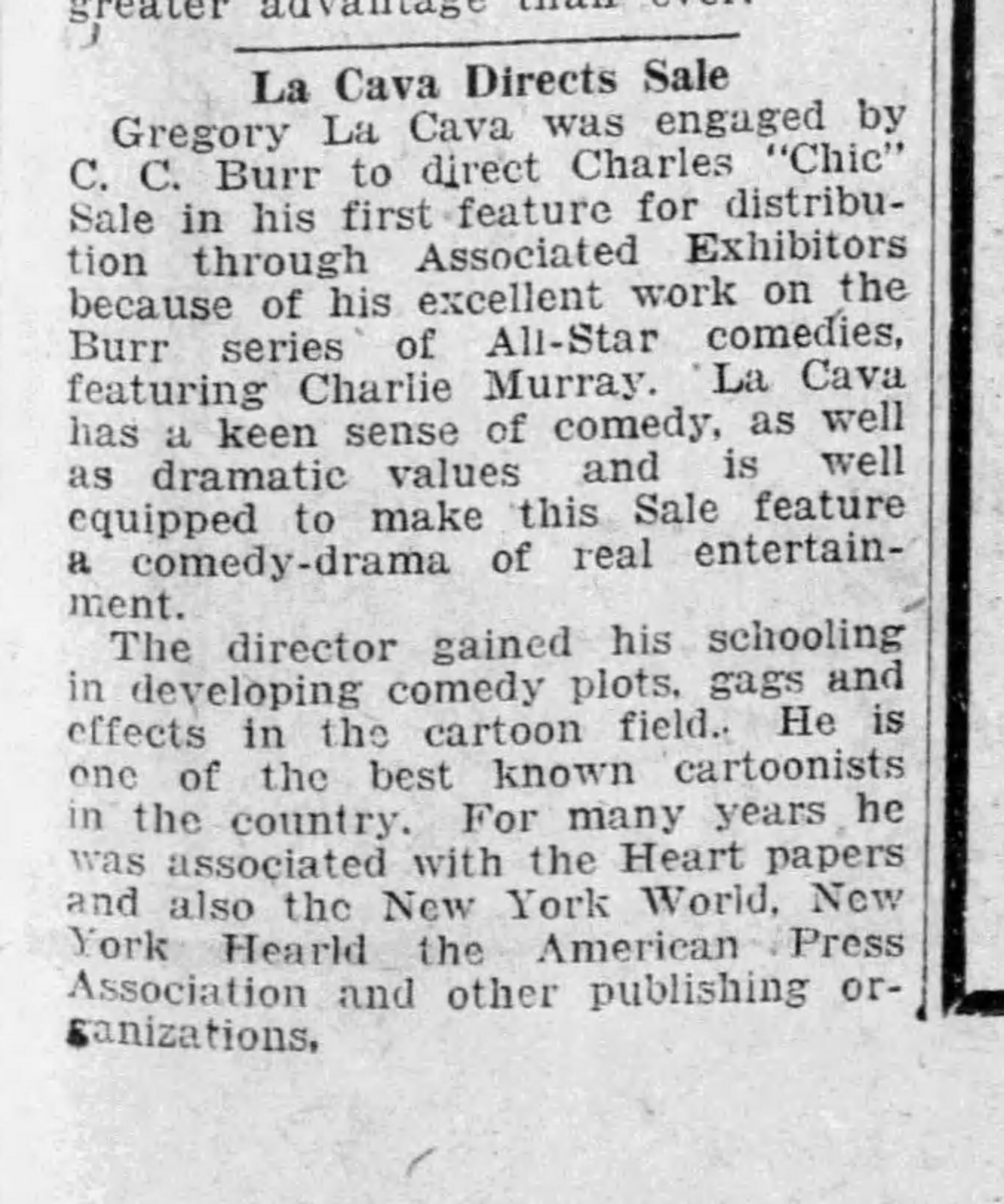
La Cava’s work on The Lucky Devil was which was how La Cava got his first job as a Gag Man in Hollywood, but this article implies that La Cava conducted no film work prior to working at Famous Players–Lasky. La Cava’s account from the 1933 issue of “Movies” magazine provides more clarity on his early work in the motion picture industry. La Cava details how he was given the opportunity to write a series of two-reelers for Johnny Hines at Mastodon Films because of his work writing scenarios for other cartoons, and the success of these two reelers resulting in La Cava being signed to direct Charlie Murray in several shorts.4 This account is the most accurate in terms of chronology, as in this period working under C. C. Burr, La Cava married Beryl Morse and is recalled by Lewis Mumford in his memoir “Sketches from Life” as having taken Mumford and Morse to a screening of one of his comedy pictures. I mention this La Cava briefly left the motion picture business following his marriage to Morse as he ceases working with Burr by 1924, until he starts on Dix pictures in early 1925. La Cava’s relationship with Richard Dix is particularly important, which I will be discussing in further detail in a following post regarding his silent feature films from 1925 to 1928, as it was at Dix’s request and the popularity that Dix held that assisted in getting La Cava back into the director’s chair.
Going back to La Cava’s brief absence from the film industry between 1924 and 1925, this was not of his own volition, as Frank Thompson discussed in his article on La Cava’s silent features; following the well-documented failure of La Cava’s first feature since His Nibs (1921), Restless Wives (1924), C. C. Burr was not particularly impressed with La Cava’s work- and La Cava was quietly publicised as “On Vacation”5 following the premiere of the film. The lack of success attached to his work with Burr explains one of the reasons for why La Cava ping-ponged back to being a gag-man and scenario writer upon connecting with fellow writer friends who moved to Hollywood with the Famous Players-Lasky company.
I wouldn’t dismiss the work La Cava moved in this period. The surviving work from this period, like his animation, hold traces of themes and interests that La Cava returned to in his later career in Hollywood. The recent discovery of one of La Cava’s Charlie Murray shorts The Pill Pounder (1923) has been pretty monumental in providing insight into La Cava’s work in this period and a major discovery for Clara Bow’s early career. I’m very grateful that David Stenn was willing to chat with me about this film, as I have currently, unfortunately, not been able to see it yet. I briefly touched on one contemporary review that mentions a slow- motion sequence, and I’m delighted to hear that it still exists in what was preserved.
In the filmography page of this blog, you can read about the type of work La Cava was producing for C. C. Burr. The fast and inexpensive comedies also typically consisted of the same cast and crew for each production, which is possibly what lead La Cava to return to certain actors, writers, and cinematographers for his later work.
- Extant films and two-reelers from this period of La Cava’s career:
- His Nibs (1921)
- The Pill Pounder (1923)
- The New School Teacher (1924)
Fragments of Restless Wives (1924) survive in a trailer, which I’ve posted about on my personal account here.
Sources:
- Trav S. D. “C.C. Burr: Excavating a Mastodon”, Travalanche, January, 30, 2021. ↩︎
- Dorothy Herzog, “Mr. Columbus Dix” (an interview with Richard Dix, Photoplay, July 1926 ↩︎
- Quentin Reynolds, “Give Me Real People”: interview with Gregory La Cava, Collier’s, March 1928. I transcribed the interview here ↩︎
- Mary A. Roberts, “Gregory the Great: an interview with Gregory La Cava,” Broadway and Hollywood “Movies” magazine, October 1933. ↩︎
- Frank Thompson, “Gregory La Cava’s Silent Features”, La Cava programme for the San Sebastian Film Festival, 1995, p.88. ↩︎


 Our Man Gregory La Cava