I started life with the ambition to become a master painter. I had the urge to use oils, to the exclusion of all else. And I was determined to be a real painter. There was no doubt in my mind but that eventually, I would succeed. With that goal in view, I worked, worked at anything that would furnish me the implements with which I meant to carve a niche for myself.1
I want to start with thanking Adam Torres of The School of the Art Institute of Chicago, Melissa Mead of the University of Rochester, and Stephanie Cassidy of The Art Students League of New York; their assistance has been wonderful. Cassidy also showed me some documents regarding La Cava and Beryl’s son’s enrolment at the Art Students League, which I have shared at the end of this post.
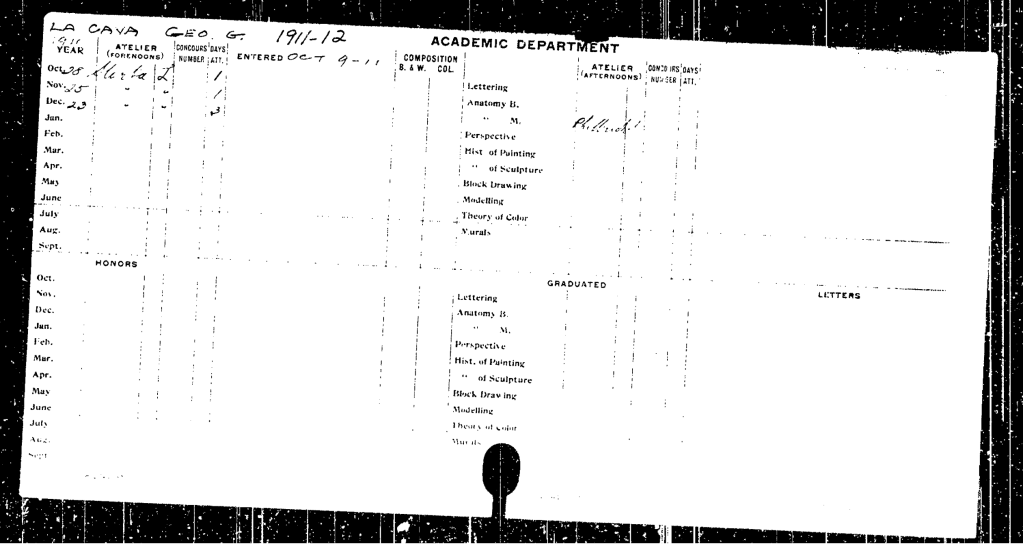
One of the many lives La Cava lived was one of a painter–an interpreter of modern life, if his reverence for George Bellows can be interpreted, and his pursuit of this passion was not a half-hearted venture. Thankfully, La Cava roughly navigated his path to filmmaking in various interviews, so we can estimate his time spent studying in these various institutions as being from 1911 to around 1912, when he pursued a career full time in cartoons. La Cava’s journey to and from painting reads like a rather screwy odyssey: starting in Rochester as a high school newspaper man for the Rochester Evening Times, and occasional boxer until injuring his fist on an opponent’s skull,2La Cava soon went to Chicago to pursue a career as a painter with studying at the Chicago Art Institute. The basis for the aforementioned time frame is built on the student records for The Art Institute of Chicago listing his enrolment in October 1911. La Cava then went from Chicago back to New York, to the National Academy of Design, and then the Art Students League. It’s difficult to estimate exactly when he enrolled at the National Academy and was a member of the Art Students League, but I’m suggesting it to be around mid 1912 at the latest.
One account listed La Cava as having attended the University of Rochester before going to Chicago to pursue painting. I did not find anything about his time at the University of Rochester in my preliminary research, and I didn’t want to speculate time frames or subject of study without confirming that he actually studied there, so I contacted Melissa Mead of the University of Rochester and she recently got back to me. Mead, having checked the archives for admissions application and transcripts, found no evidence that Gregory La Cava attended the University of Rochester. It is true that not all records survive, but it’s safe to say this account is partially false. Most accounts, from La Cava and various contemporary articles, mention him as only attending high school in Rochester, then going to study in Chicago.3
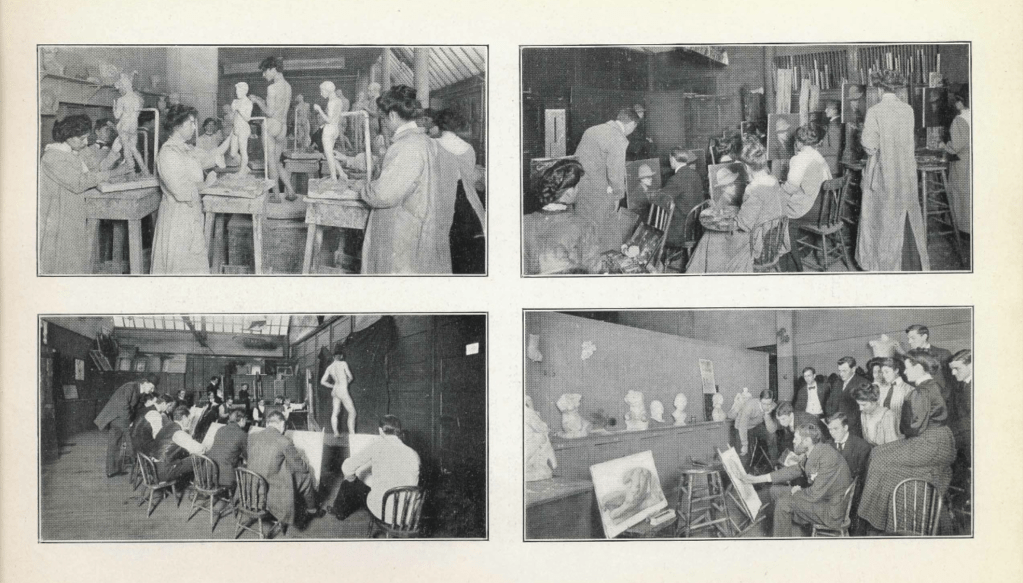
La Cava’s studies in New York, and the artists he learned from, are what he recalls in later accounts in more detail. Cassidy shared course catalogues with me from the 1910s, which provide some insight to La Cava’s time at the Art Students League. The focus on life drawing, with three classes specialised in just that, sharpened La Cava’s focus on the minute expressions of people-making him one of the greatest studiers of the stars and their personalities. When La Cava was asked what he looks for in his actors, he responded: “I like flowing lines, subtle lightning quick changes of moods, thought-flashes that sweep across the faces of our artists. I like it; I can’t tell you how much.” (“Movies” interview, 1933). La Cava’s examination and elevation of complete emotional honesty in his actors performances, this ability to capture those lightning quick changes of moods, are indicative of the skills of human examination developed by his artistic studies. “It was very much art for art’s sake with me,” La Cava later explained. “I worked night and day, slaved over anatomy, joyed in oil painting.”4 I believe his studies at the Art Students League specifically were the most significant and had a great influence on him, as he states he was part of the “Robert Henri School.” An independent artist perceivably rebellious to the traditions of fine art institutions appears like the perfect figure for La Cava to study from. La Cava, despite limited funds, reportedly leaving the Arts Student League to set up his own studio5 is indicative of his teacher’s influence. Henri encouraging his students to let their paintings “show the vibration of breathing,”6 and to “paint like a fiend when the idea possesses you,”7 also comes into consideration when observing the reputation La Cava gained as an artist with a meticulous attention to the natural language of each character, and with a comparatively minimal output a year because of his investment in one film over a course of months.8
La Cava lists one of his instructors as George Bellows, stating: “he was a fine man, an inspiration to all his students” (“Movies” interview). Bellows was a teacher at the Arts Student League from around 1909 onwards, so despite and Cassidy and me not finding much of La Cava’s course records, it can be confirmed that La Cava studied under Bellows. Moreover, as previously mentioned, it is too tempting to compare some of La Cava’s subjects to Bellows’s. I can’t help but think of Bellows’s Men of the Docks (1912) when I see La Cava’s “forgotten men” in My Man Godfrey (1936) now.
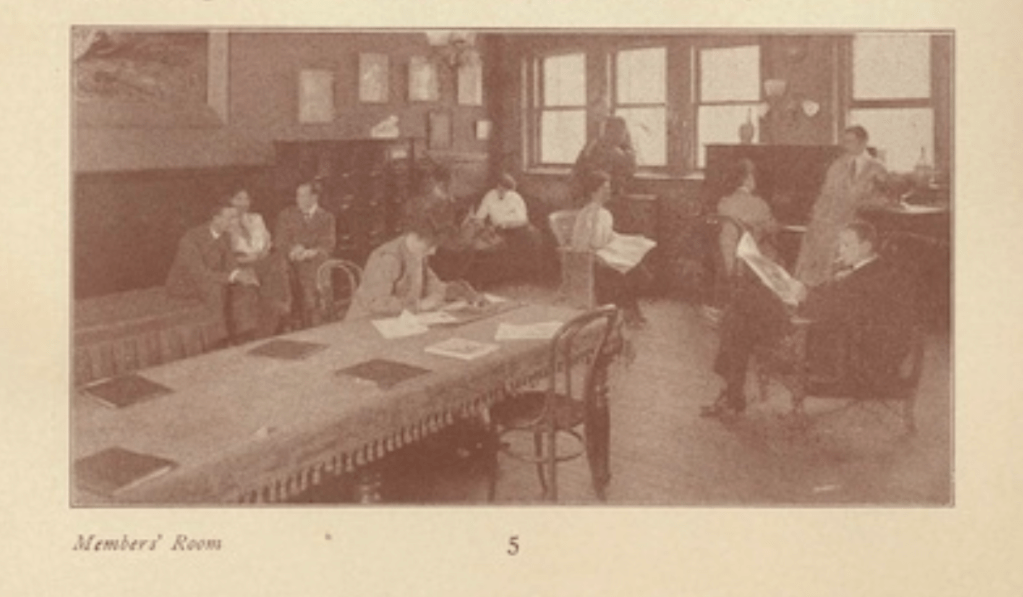
It is possible that if La Cava had the financial means to stay in art, he may have become a master oil painter; his devotion to his craft is undeniable in all mediums, but there seemed to be this natural pull towards the motion picture. It would be incredible if any of La Cava’s paintings during his periods of study have survived. I wouldn’t be surprised if his art was just as dynamic as his later work. He was always “trying for a live picture with real people in it.”9
Courtesy of Stephanie Cassidy and the Arts Students League, here is Gregory and Beryl La Cava’s son’s 1942 student records:

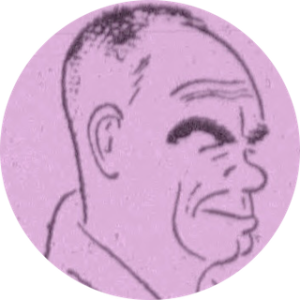
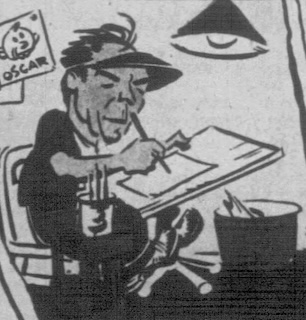
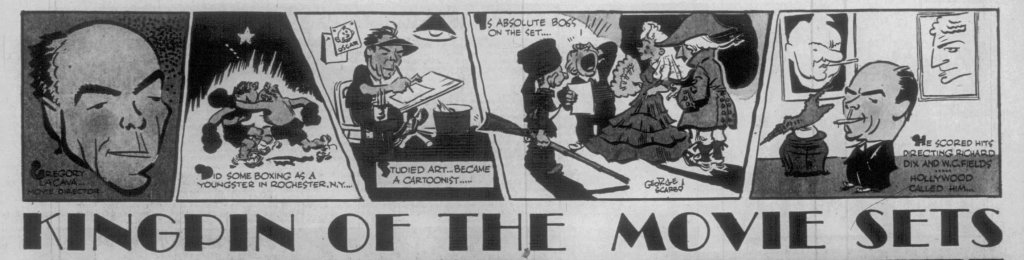
The heading image is from a fun biographical cartoon strip by George Scarbo, which I have clipped the whole strip to below. It’s wonderfully fitting for La Cava’s life to be interpreted by a fellow cartoonist:
Works cited:
- Mary A. Roberts. “Gregory the Great: an Interview with Gregory La Cava”, Broadway and Hollywood “Movies”, October 1933. ↩︎
- Examples of some of these accounts and interviews with La Cava: “Brief Biography: Gregory La Cava”, The Bayonne Times, Tuesday 08 April 1941, Elizabeth Copeland, “Energetic and Painstaking Production Secrets of Director La Cava’s Success”, The Richmond News Leader, Saturday 24 Feb 1940, Dee Lawrence, “Kingpin of the Movie Sets”, The Salt Lake Tribune, Sunday 14 Sep 1941. ↩︎
- Dee Lawrence, “Kingpin of the Movie Sets”, The Salt Lake Tribune, Sunday 14 Sep 1941. ↩︎
- “Brief Biography: Gregory La Cava.” ↩︎
- Robert Henri, Art Spirt, p. 245. ↩︎
- Art Spirit, p. 166. ↩︎
- An example of this reputation La Cava developed can be seen in articles following Stage Door (1937), such as: Elizabeth Copeland, “Energetic and Painstaking Production Secrets of Director La Cava’s Success.” ↩︎
- “La Cava Uses ‘Off-Cuff’ Method In Shooting His Film Scenes,” The Richmond News Leader,
Monday 01 Apr 1940. ↩︎

 Our Man Gregory La Cava